
Read the full food label before treating the word “organic” as a claim about the entire product. A statement about named ingredients, a certified product claim and a statement about where food was grown answer different questions. Keeping them separate makes a market or grocery comparison more useful.
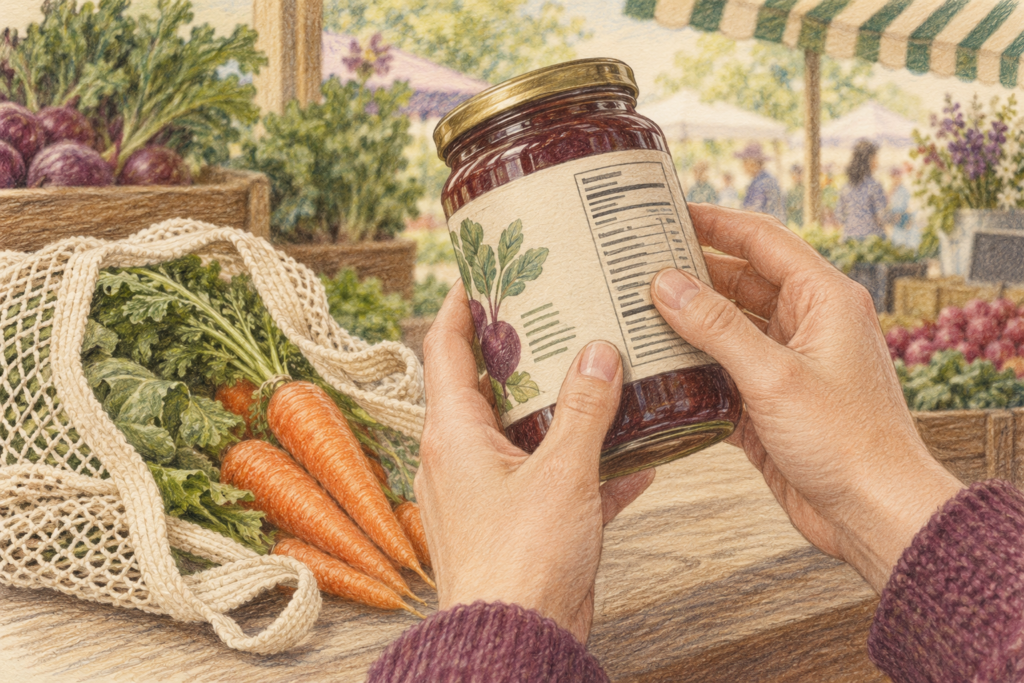
Check which part of the label makes the claim
USDA’s organic labeling guidance distinguishes these categories for food products. Its percentage calculations exclude salt and water.
| Label category | Basic distinction |
|---|---|
| 100 percent organic | All ingredients meet the organic category, apart from excluded salt and water. |
| Organic | At least 95 percent organic ingredients, with restrictions on the remainder. |
| Made with organic… | At least 70 percent organic ingredients, subject to additional conditions; the USDA organic seal is not permitted. |
| Specific organic ingredients | A product with less than 70 percent organic content can identify qualifying ingredients in its ingredient statement; that does not make the finished product organic. |
This is a consumer reading aid, not instructions for approving a commercial label. Producers should use the full rules and their certifier’s guidance. Source checked October 11, 2026.
Try a fictional package comparison
Imagine one jar whose front label makes an organic product claim and a second jar whose ingredient list identifies one organic ingredient. Copy the exact wording into separate rows. Do not shorten both entries to “organic jar.” That shortcut erases the difference you are trying to compare.
Now add a separate origin column. Where the product was grown or made is a different question from the ingredient claim. A nearby address on a package is not, by itself, a complete account of where every ingredient came from.
Bring three questions to the market
- What is the exact claim about this particular product?
- Where can I read the ingredient, certification or producer information supporting it?
- What does the seller know about where it was grown or made?
Ask about the item you plan to buy, rather than assuming every product at a stall has the same status. Record a grower’s description as a grower’s description. If a detail matters to your purchase and remains unclear, keep it unresolved until the responsible seller or certifier can clarify it.
Use the comparison for your own priorities
You may care about ingredient certification, local connections, price or practical use in your kitchen. Keep those preferences in separate columns so one attractive word does not substitute for the whole decision. Nothing in this comparison establishes that a food is healthier, safer or suitable for a particular person’s needs.
Read our listing standards for how Kitsap Organics describes resources, then explore local food connections.